
Guide · Indoor Plants
Why houseplants struggle under grow lights - and what actually works
Grow lights promise lush growth. Many deliver disappointment. Here's why the complete solar spectrum is still the gold standard for demanding houseplants - and how to bring it into the darkest room.
The grow light premise - and its limits
Grow lights are designed around PAR - photosynthetically active radiation, the wavelength range (roughly 400–700 nm) that plants use for photosynthesis. A standard red-blue LED grow light targets the two absorption peaks of chlorophyll: deep red (~660 nm) and blue (~430 nm). This approach works well for fast-growing crops in controlled conditions - lettuce, herbs, microgreens.
For tropical houseplants, orchids, ferns, ficuses and other light-hungry specimens, the story is more complicated. These plants evolved in environments with the full richness of solar radiation, and they use a much wider range of signals than just red and blue.
What real sunlight has that grow lights don't
Real sunlight is spectrally complete. Beyond red and blue, it delivers:
- Green wavelengths (500–600 nm) - often dismissed as irrelevant since leaves reflect green light. In fact, green penetrates deeper into leaf tissue and reaches chloroplasts that red/blue can't reach, contributing meaningfully to overall photosynthesis in dense canopies.
- UV-A and UV-B (280–400 nm) - these trigger the production of stress-protective pigments (anthocyanins, flavonoids), compact growth, thicker leaves and stronger stems. Plants grown under UV-deficient light often become etiolated - stretched, pale, structurally weak.
- Far-red (700–800 nm) - the ratio between red and far-red (R:FR ratio) is one of the most important signals in plant biology. Plants use it to detect shade (low R:FR = neighbours above = reach upward) and to regulate flowering, germination and dormancy. A static grow light delivers a fixed R:FR ratio that cannot mimic the dynamic shift of real daylight.
The intensity problem in dark rooms
Beyond spectrum, intensity matters. Many tropical houseplants require 2,000–5,000 lux for healthy growth; direct sunlight delivers 40,000–80,000 lux. A north-facing room in Central Europe rarely exceeds 500–800 lux at the window on a sunny day. Deep inside the room, values of 100–200 lux are common.
Grow lights can partially address intensity, but they generate heat, consume electricity and still cannot replicate the spectral richness of direct sunlight. A heliostat redirects natural intensity - direct, unfiltered sunlight - straight to the plant location. No running costs for the light source, no heat overhead, and no spectrum compromise.
How the ohoya Heliostat works for plants
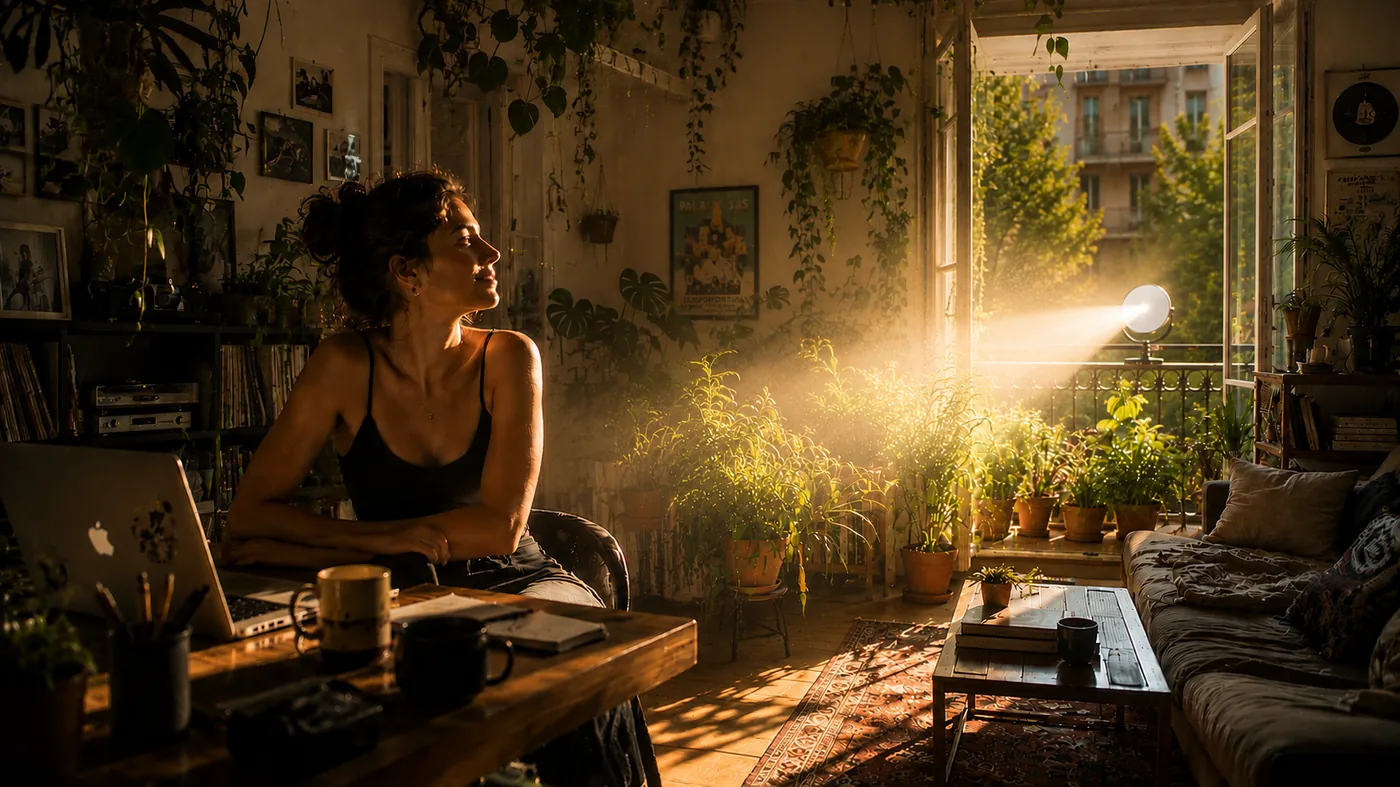
The ohoya Heliostat mounts outdoors where the sun reaches - a south-facing wall, garden corner, terrace or ground anchor - and redirects real, unfiltered sunlight indoors, through a window, onto the plant location you've set. The light patch re-aims itself automatically as the sun moves, maintaining coverage through the day. The plant receives the same quality of light it would experience standing in a sunny garden: full spectrum, dynamic, UV-inclusive, and intense enough to drive vigorous photosynthesis.
For a dark north-facing room that has never seen direct sun, this can unlock plant species previously impossible to grow there - without adding any electrical load or periodic bulb replacements.
What to realistically expect
No growth or yield promises. ohoya redirects real, full-spectrum sunlight to your plant's spot - it does not guarantee growth, flowering or yield. Results depend on the species, how many hours of sun your location gets, room conditions and your care. The heliostat is in pre-series development; performance statements describe the properties of redirected natural sunlight, not a guaranteed plant outcome.
- A moving patch of real sun, for the hours it reaches the mirror - not 24/7 grow-light coverage.
- It follows the weather. Heavy overcast means little direct sun to redirect.
- Broad light, no focal point. A slightly convex mirror creates no focal point, so nothing is brought to a focus on the leaves. Where the light may fall is set by no-glare zones in firmware, a safe park position and the siting notes you follow.
Frequently asked questions
Will a heliostat guarantee my plants grow better?
No - we make no growth or yield promises. It delivers real, full-spectrum sunlight to the spot you choose; how a plant responds depends on its species, the sun hours your location gets, room conditions and your care.
Is a heliostat better than a grow light?
It's a different thing: real, full-spectrum, dynamic sunlight with no running cost for the light and no added heat - but only when and where the sun reaches the mirror. A grow light is constant and works at night; the sun is richer but follows the weather.
Is the redirected sunlight safe for a room with plants?
The mirror is slightly convex and creates no focal point, so the leaves see a broad area of daylight and nothing is brought to a focus on them. Keeping the light where you want it rests on three measures, not on the mirror shape - no-glare zones enforced in firmware, a safe park position, and the siting notes you follow when you place it.
Does ohoya use a camera or the cloud?
The device has no camera, ever (the app uses your phone's camera only for the one-time AR setup, images stay on your phone), and no cloud is required - everyday operation works without an internet connection.
Real sunlight for your plants - wherever they are
The ohoya Heliostat redirects the full solar spectrum through a window to any plant location you choose - automatic, all day. Reserve from €49, fully creditable and refundable any time.